Wondering whether an ADU is a smart move for your Mar Vista property? You are not alone. On the Westside, an ADU can create rental income, add flexibility for family or guests, and potentially improve resale appeal, but it can also bring added cost, design tradeoffs, and property-specific permit issues. If you own in Mar Vista, the right answer depends less on the trend and more on your lot, your goals, and your timeline. Let’s dive in.
Why ADUs matter in Mar Vista
Mar Vista is a strong place to ask this question because housing costs and rents are both high. In March 2026, Realtor.com reported a median listing price of $2.1 million and a median rental price of $2,800 in Mar Vista, with 194 rentals available. It also classified the neighborhood as a seller’s market.
That creates a practical case for ADUs. If you can add usable living space in a way that fits your property well, you may gain long-term flexibility, income potential, and broader buyer interest later. Still, not every lot supports an ADU equally well, so the decision should start with feasibility, not enthusiasm.
ADU feasibility is lot-specific
One of the biggest misconceptions about ADUs is that a whole neighborhood can be treated the same way. In Mar Vista, that is not the case. The area sits within the Palms-Mar Vista-Del Rey Community Plan Area, and zoning conditions and overlays can vary by parcel.
That matters because your property may have different design or review considerations than a nearby home. For example, some parcels may fall within overlays such as the Gregory Ain Mar Vista Tract HPOZ, where new work must complement historic character. Before you assume a detached unit or conversion will work, it is important to evaluate your specific lot.
What counts as an ADU in Los Angeles
The City of Los Angeles treats ADUs as attached, detached, or converted living units on the same lot as a primary residence. A JADU, or junior accessory dwelling unit, is different. It must be contained within a single-family home or accessory structure and is capped at 500 square feet.
Los Angeles adopted its ADU ordinance in 2019, and state law requires local agencies to approve or deny ADU and JADU permits ministerially within 60 days. That timeline can help with planning, but it does not remove the need for a careful design and permit strategy upfront.
Key rules that can shape your project
A few baseline rules have a big impact on whether an ADU makes sense for your Mar Vista property.
Size and setback rules
Current California guidance says local governments may not use minimum lot-size rules to block ADUs. It also says lot coverage or floor-area-ratio limits cannot prevent an 800-square-foot ADU that maintains four-foot rear and side setbacks.
That can be especially helpful on smaller Westside lots. Even if your site feels constrained, a compact detached ADU may still be possible when the layout is handled carefully.
Parking rules
Parking can be a major concern in Mar Vista, but ADU rules can reduce that burden. Parking is capped at one space per unit or bedroom, tandem parking is allowed, and no parking can be required in several common situations, including when the ADU is within a half-mile walking distance of public transit.
That said, parking still matters from a lifestyle and resale standpoint. Even when extra parking is not legally required, losing too much functional parking can change how the property feels to future buyers.
Existing space conversions
If you are thinking about converting a garage or other existing area, the rules can be more favorable. Conversions of existing space are not subject to unit-size rules.
There may also be practical savings. California guidance says existing-space conversions generally cannot be forced to add a new or separate utility connection unless they are built at the same time as a new single-family home.
Four common ADU paths in Mar Vista
Most homeowners in Mar Vista tend to choose from four practical approaches. The best one depends on your yard, budget, privacy goals, and intended use.
Detached backyard ADU
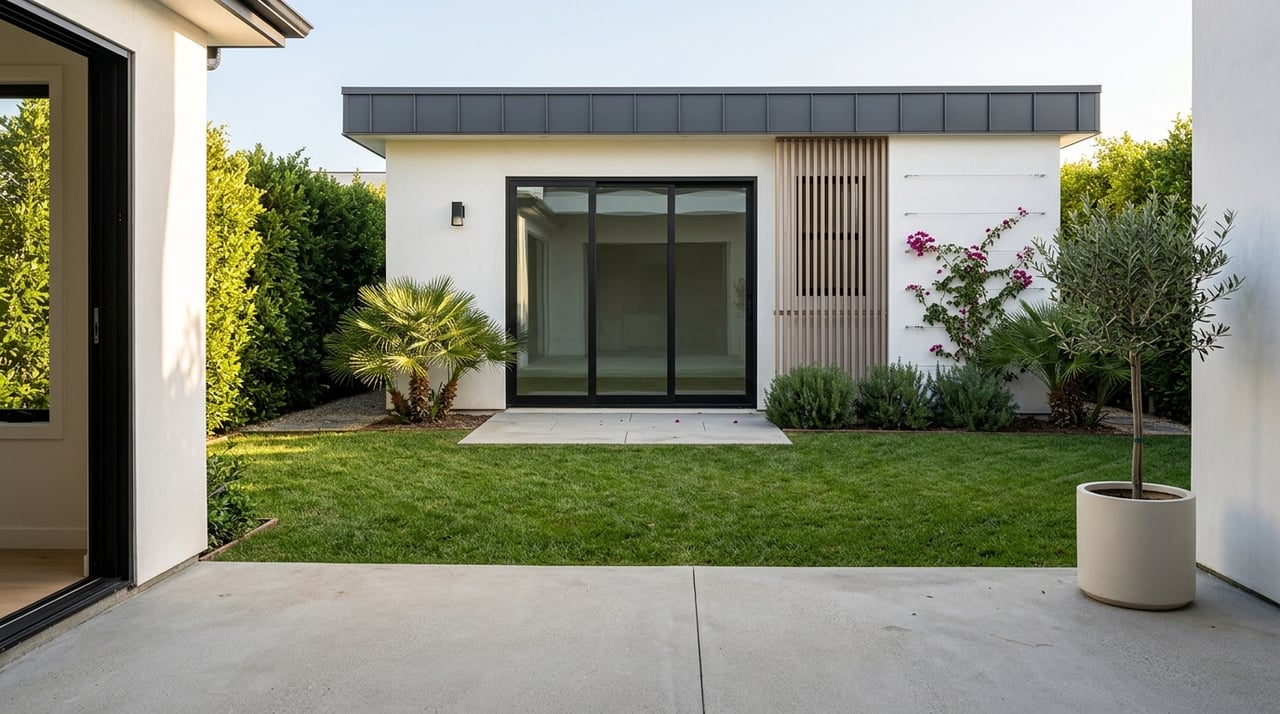
A detached ADU often offers the best privacy for both the main house and the new unit. It can work well if you want long-term rental use or flexible guest or family space.
The tradeoff is usually cost and site impact. A detached build often requires more construction, more utility planning, and more attention to yard layout and access.
Garage conversion
A garage conversion can be one of the more efficient ways to add living space. If your garage is well placed and structurally suitable, this route may reduce construction complexity compared with a ground-up unit.
It can also help preserve more open yard area. The downside is that you are giving up enclosed parking or storage, which can affect day-to-day function and future buyer perception.
Attached addition
An attached ADU can make sense if your home layout and lot shape support it. This option may allow a more integrated design while still creating a separate living area.
The challenge is privacy and flow. If the addition feels too connected or compromises the original house layout, the result may be less appealing than a smaller but better-planned detached or converted unit.
JADU inside the home
A JADU can be a lower-impact way to create extra living space. Because it is capped at 500 square feet and must be within the home or an accessory structure, it usually works best when you want modest flexibility rather than a fully separate larger unit.
For some owners, a JADU offers the most sensible cost-to-use ratio. It may not produce the same rental or resale impact as a larger detached ADU, but it can still add meaningful utility.
How standard plans can help
Los Angeles offers a standard-plan library with pre-approved ADU options ranging from small studios to larger plans up to 1,200 square feet. According to LADBS, these plans can shorten plan-check time.
For Mar Vista owners, this may be especially useful when the lot is tight or when speed matters. Compact detached units and garage conversions can benefit from a more streamlined permitting path when standard plans fit the site and the goal.
Budget ranges to expect
ADU costs in Los Angeles can vary widely, so it is better to think in ranges than fixed numbers. Local 2026 cost guides put fully finished detached ADUs around $220 to $400 per square foot, while another local guide places detached ADUs at $280 to $400 per square foot and roughly $200,000 to $480,000 for a 700- to 1,200-square-foot unit.
Garage conversions are often lower, with one local design-build guide estimating about $80,000 to $180,000. These are planning estimates, not bids. Site conditions, finish level, utility work, access, and setbacks can all push the number up or down.
Why size can change the math
In many ADU projects, size is not just about function. It can also affect fees and total project cost.
California guidance says ADUs of 750 square feet or less are exempt from local agency, special-district, and water-corporation impact fees. JADUs of 500 square feet or less are also exempt from those same fees. That means the jump from 500 to 750 to 1,000-plus square feet can meaningfully change your budget.
Rental income potential in Mar Vista
If your goal is income, Mar Vista has data that support a careful look. Realtor.com reported a median rent of $2.8K in the neighborhood as of March 2026, while Zillow put Los Angeles typical rent at $2,892 in April 2026.
That does not guarantee what your future ADU would rent for. Still, it shows that the broader market remains expensive, and a well-designed unit may help offset ownership costs or provide flexibility for family use over time.
Resale value and buyer appeal
An ADU can also influence future resale, but the value is not automatic. A UC Irvine summary of a 2024 Real Estate Economics paper found that ADU presence in Los Angeles raised assessed value and selling price by 7% to 9%. FHFA California data also showed stronger appraised value growth for properties with ADUs between 2013 and 2023.
That is encouraging, but in Mar Vista, fit matters as much as square footage. Buyers often care about privacy, outdoor space, parking, and flexibility. If an ADU feels well integrated into the site, it may strengthen marketability. If it overwhelms the lot or creates awkward circulation, it may feel more like a compromise.
Property tax and carrying-cost considerations
Before you build, it is smart to look beyond construction cost. California’s Board of Equalization says new construction triggers reassessment of the newly built portion at fair market value, while the existing improvement is not affected.
In plain terms, your property taxes may rise based on the value of the new ADU. That does not mean the project is a bad idea. It does mean the long-term monthly math should include more than rent potential or resale hopes.
Rental rules to review before building
If your property has any current rental component, review that carefully before making plans. LAHD says ADU and JADU status can affect whether a property falls under the Rent Stabilization Ordinance.
LAHD also notes that home-sharing is not allowed in units subject to the RSO. It further states that removing a tenant’s parking space can require a rent reduction. For owners with existing tenants or income-producing property, these issues should be clarified before construction starts.
Questions to ask before saying yes
If you are trying to decide whether to add an ADU, these are often the most useful questions:
- Does your parcel support a detached unit without sacrificing too much yard or privacy?
- Would a garage conversion or JADU produce a better cost-to-income ratio?
- Could parking changes create lifestyle, tenant, or resale issues?
- Will the added construction still make sense after tax and carrying-cost changes?
- Is your goal long-term rental income, multigenerational flexibility, resale appeal, or some combination?
A good ADU is not just legally possible. It also needs to make sense for how you use the property and how future buyers may view it.
When an ADU makes the most sense
In Mar Vista, an ADU often makes the most sense when your lot can handle it cleanly, the design preserves privacy and outdoor function, and the budget aligns with a clear long-term goal. Smaller, efficient units can be especially compelling when they avoid certain fees and reduce construction complexity.
On the other hand, if the project would force a cramped layout, eliminate too much usable yard, or create parking and tenant complications, the return may be less attractive than it first appears. The best decisions are usually grounded in site specifics and careful financial thinking, not just market buzz.
If you are weighing an ADU as part of your larger property strategy in Mar Vista, Vida Ash can help you think through how the addition may affect livability, buyer appeal, and long-term value on the Westside.
FAQs
Should you add an ADU to a Mar Vista property for rental income?
- It can make sense if your lot supports the design well and the total cost, tax impact, and rental rules still fit your long-term plan.
What is the size limit for a JADU in Los Angeles?
- A JADU is capped at 500 square feet and must be contained within a single-family home or accessory structure.
How fast are ADU permits processed in Los Angeles?
- State law requires local agencies to approve or deny ADU and JADU permits ministerially within 60 days.
Do Mar Vista ADUs always require parking?
- No. Parking cannot be required in several common situations, including when the ADU is within a half-mile walking distance of public transit.
Can a garage conversion be easier than a detached ADU in Mar Vista?
- Often yes, because existing-space conversions may avoid some of the complexity tied to new utility connections and full ground-up construction.
Will adding an ADU change property taxes in California?
- Yes, new construction can trigger reassessment of the newly built portion at fair market value, while the existing improvement is not affected.
Do ADUs add resale value in Los Angeles?
- Research cited in California and Los Angeles suggests ADUs can improve assessed value and selling price, but the result depends on design, location, and overall fit with the property.